Standards & Regulations

42 standards, regulations and frameworks integrated into our platform to ensure your compliance.

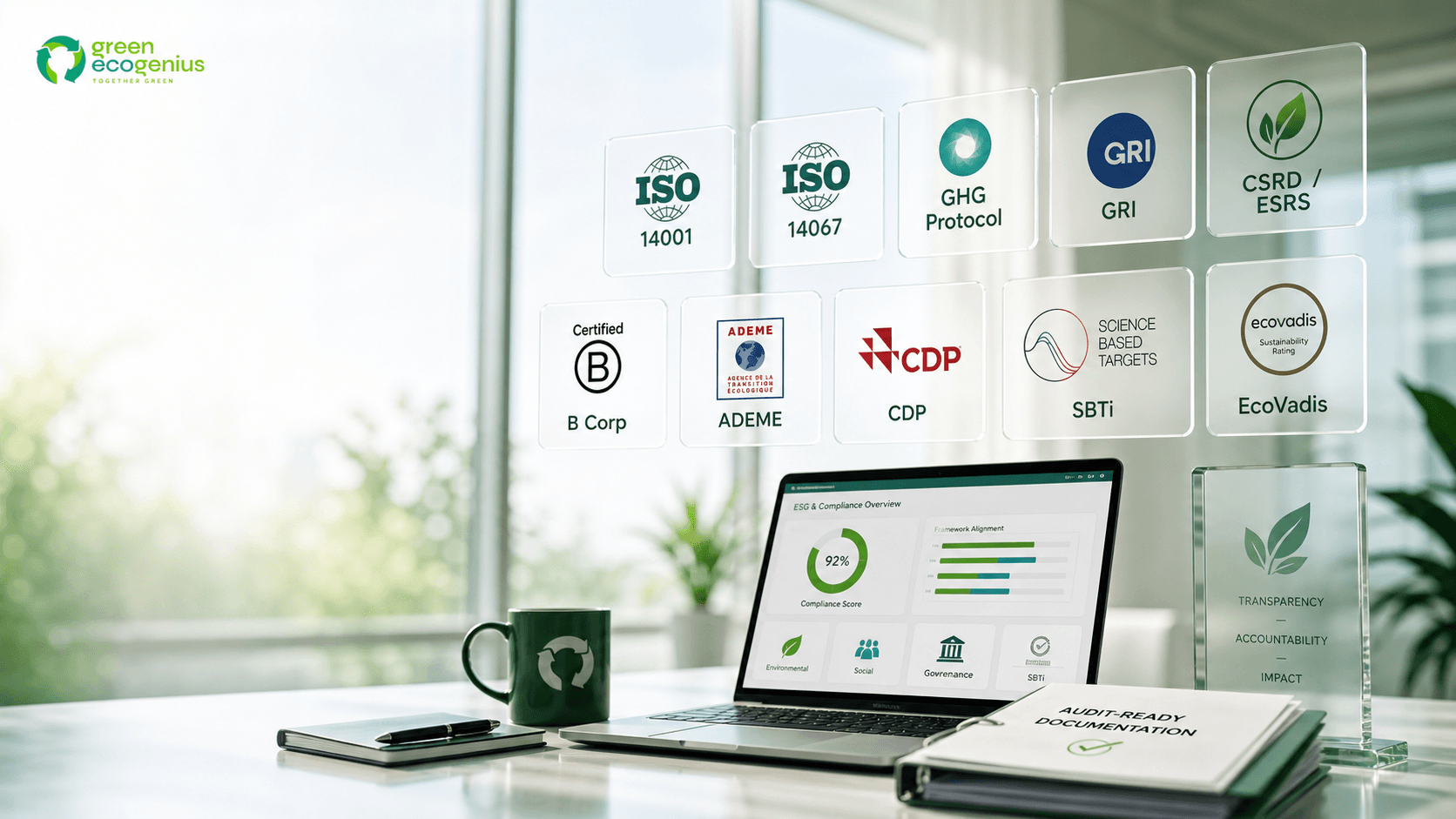
GreenEcoGenius is the only B2B circular economy platform that natively integrates ISO standards, international regulations, and ESG reporting frameworks into every feature.

0

integrated standards

0

pillars covered

0

ISO standards

0

regulations

0

targeted labels

Circular Economy & Waste Management

11 integrated standards

Circular Economy & Waste Management

These standards govern the transition to a circular model. GreenEcoGenius applies them automatically in The Circular Marketplace, traceability and reporting.

ISO 59004:2024

Circular economy -- Vocabulary, principles and recommendations

Fundamental

First international standard defining the common vocabulary of the circular economy. Establishes founding principles: circular resource flow, ecosystem resilience, systemic approach.

ISO StandardPublished 2024

All GreenEcoGenius terminology is aligned with this standard. Every feature uses ISO 59004 vocabulary.

ISO 59010:2024

Circular economy -- Guidelines for business models and value chains

Strategic

Guides organizations to transform their business model toward circularity. Covers eco-design, reuse, repair and recycling.

ISO StandardPublished 2024

The Circular Marketplace materializes these guidelines: secondary materials marketplace, buyer-seller matching, functionality economy.

ISO 59014:2024

Traceability of secondary materials valorization

Strategic

Principles, requirements and recommendations for the traceability of secondary materials from one company to another. This is exactly the GreenEcoGenius blockchain use case.

ISO StandardPublished Oct. 2024On-chain

Each lot traced on Polygon meets this standard: SHA-256 recording, geolocation, timestamping, immutable chain of trust.

ISO 59020:2024

Circular economy -- Measurement and assessment of circularity

Strategic

Framework for measuring circularity of organizations and products. Circular performance indicators, recycling rates, lifespan.

ISO StandardPublished 2024

Circularity indicators (recycling rate, CO2 avoided, tonnes valorized) are calculated per this standard in the Carbon Impact dashboard.

ISO 14001:2015

Environmental management systems

Essential

The global reference for environmental management systems. PDCA framework (Plan-Do-Check-Act) for continuous improvement of environmental performance.

ISO StandardPublished 2015

The platform follows the PDCA framework for environmental management. The Compliance module assesses ISO 14001 alignment.

Loi AGEC (n. 2020-105)

Anti-Waste for a Circular Economy Act

Mandatory

French framework law for the transition to circular economy. End of single-use plastics by 2040, 3R decree, mandatory 9-stream sorting, extended EPR.

French LawIn force since 2020

The Circular Marketplace integrates AGEC obligations: 9-stream classification, waste traceability, EPR facilitator for businesses.

Decret 9 flux (n. 2021-950)

Source sorting and separate collection of business waste

Mandatory

Mandatory sorting and separate collection of 9 waste streams for businesses. Extension to bio-waste and textiles in 2025.

French DecreeIn force since 2021

The Marketplace automatically classifies each lot according to the 9 regulatory streams. Traceability proves source sorting compliance.

REP elargie

Extended Producer Responsibility

Mandatory

Producers are responsible for the end of life of their products. Extension to industrial packaging, textiles, furniture, toys.

French LawIn force

The platform facilitates EPR compliance: waste traceability, valorization certificates, mandatory reporting.

PPWR (UE 2025/40)

Packaging and Packaging Waste Regulation

Upcoming

Target: 100% recyclable packaging by 2030. Mandatory recycled content rate, digital passport, over-packaging ban.

EU RegulationApplies 2030

GreenEcoGenius anticipates PPWR: packaging traceability, recycled content rate calculation, digital passport preparation.

Taxonomie UE (Objectif 4)

Transition to a circular economy

Essential

Objective 4 of the EU Taxonomy defines alignment criteria for economic activities with the circular economy.

EU RegulationIn force

ESG reporting includes taxonomic alignment assessment for Objective 4. Marketplace data automatically feeds this assessment.

DPP (Digital Product Passport)

Digital Product Passport

Upcoming

Future unique identifier for each product containing its manufacturing history, composition, repairability and recyclability.

EU RegulationIn developmentOn-chain

The GreenEcoGenius blockchain is already designed for DPP: each lot has a unique identifier, immutable history and complete metadata.